
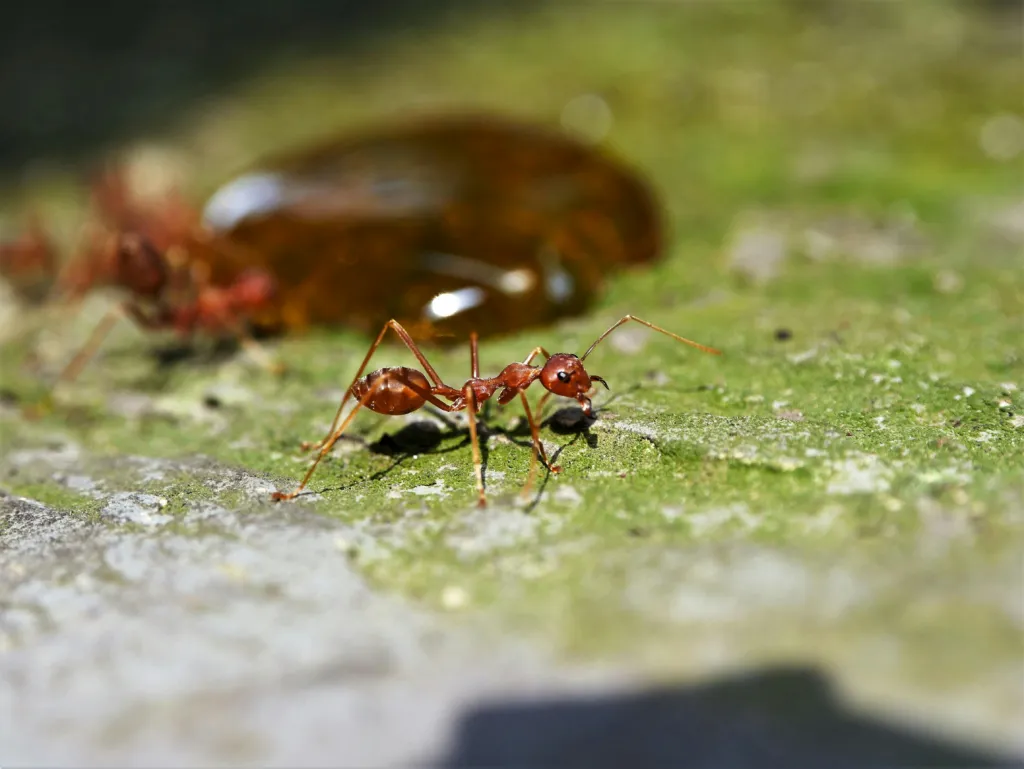
Learn About Species of Ants That Are a Threat In Florida
Quick Synopsis:
- Different ant species require different control strategies.
- Identifying what type of ant you’re dealing with before treating is the most important first step.
- Spraying visible ants addresses only a fraction of the colony and can make certain species worse by triggering colony splitting.
- Bait-based treatments outperform sprays for most indoor ant problems because they reach the queen and brood.
- Florida’s warm, humid climate supports a wide range of ant species year-round, with activity peaking in spring and fall.
- The pest experts at Plant It Earth created this list of common types of ants, risks they may pose, and the best ant control methods.
Start by Identifying the Ant Type
A treatment that’s highly effective against one species can be completely useless against another. Taking a few minutes to observe before reaching for a product is key.
Start with location. Where the ants are foraging and where they seem to be originating from narrows the field considerably. A dome-shaped mound rising from an open, sunny section of lawn points strongly toward fire ants. Fine, sawdust-like material near a baseboard or window frame suggests carpenter ants. Mud channels bridging soil and wood near a damp area are typically the work of moisture ants.
Consider size and color. Are they large or barely visible? Black, reddish-brown, yellow, or some combination? Is the abdomen notably elongated or almost heart-shaped?
Watch how they move. A disciplined, single-file column is characteristic of odorous house ants or Argentine ants. Ants that scatter in multiple directions with no apparent order are almost certainly crazy ants.
Use your nose. Crushing a single ant and noting the odor is a surprisingly reliable identification tool. A rotten coconut smell indicates either odorous house ants or ghost ants. A faint citrusy or sharp chemical odor points elsewhere.
Taken together, these clues narrow the range of possibilities, which changes what you reach for and how you use it.
Types of Ants You Should Know
Thousands of ant species exist across North America. A much smaller number show up in Florida homes and yards. Here’s what to know about the ones most likely to appear in the Tampa and Sarasota area.
Fire Ant
Appearance: The most reliable identifier is the mound itself. It’s a raised, dome-shaped structure with no visible surface opening, typically located in open, sun-exposed turf.
Risk: Fire ants sting repeatedly rather than biting, injecting an alkaloid venom that produces a burning sensation and raised pustules. For individuals with venom allergies, an encounter with a disturbed mound is a genuine medical emergency. For everyone else, it’s still an experience worth avoiding.
Control: For fire ant control, distribute granular bait across the surrounding area rather than applying product directly to the mound. Direct mound treatment disrupts foraging activity before workers can carry bait back to the colony.
Pharaoh Ant
Appearance: One of the smaller species encountered indoors with workers measuring just 1.5 to 2 mm. Coloring ranges from nearly translucent to pale yellow or light reddish-brown.
Habitat and risk: Pharaoh ants seek warm, humid environments and can nest inside walls, beneath flooring, and within almost any protected void. They are documented vectors of pathogens including Staphylococcus and Streptococcus.
Control: This is the species where conventional sprays cause the most direct harm to the treatment outcome. When a pharaoh ant colony senses chemical disruption, it responds by fracturing into multiple sub-colonies (called budding). Slow-acting bait, deployed patiently and methodically, is the only approach that consistently produces results.
Ghost Ant
Appearance: Exceptionally small at approximately 1.5 mm, with a dark head and thorax that contrast against translucent, nearly colorless legs and abdomen. Crushed workers release a faint coconut scent.
Habitat: Ghost ants are primarily a warm-climate species and are especially common in Florida. They’re drawn to sweet food sources and enter structures through the smallest available gaps
Control: The multi-queen, multi-site colony structure makes self-treatment inconsistent at best. Professional baiting programs designed around the species’ dispersed nesting behavior produce substantially more reliable outcomes.
Twig Ant
Appearance: Noticeably elongated and slender compared to most ants, frequently patterned in orange and black, with prominent eyes that give them an almost wasp-like profile.
Habitat: Twig ants establish colonies inside hollow branches, dead twigs, and woody plant stems. They’re common throughout Florida and across the Gulf South.
Risk: These ants sting when provoked, and encounters happen most often during yard work, pruning, or any activity that brings hands near shrubs and trees.
Crazy Ant (Caribbean Crazy Ant)
Appearance: Workers measure roughly 1/8 inch, covered in a distinctive coat of reddish-brown hairs, and move in the scattered, directionless pattern that gives the species its name.
Habitat: In Florida, they’re active outdoors year-round and commonly push inside following heavy rain or as outdoor temperatures shift.
Control: Multi-queen colony structure makes perimeter sprays nearly useless. Effective management focuses on sealing structural entry points, pulling back vegetation from the building exterior, and using bait.
Citronella Ant (Yellow Ant)
Appearance: Workers are 4 to 5 mm with yellow-to-amber coloring. The reproductive members of the colony are larger and winged and frequently mistaken for termites.
Habitat: Citronella ants nest underground, typically beneath concrete slabs, along building foundations, and in crawlspaces. But they pose no threat to wood or building materials and are harmless to humans.
Control: The late-summer swarms can look alarming, particularly given the resemblance to termites, but they’re short-lived and self-resolving.
Army Ant
Appearance: Approximately 1/4 inch, dark brown to black with a subtly orange-tinted abdomen and notably large mandibles built for subduing prey.
Habitat: Unlike virtually every other ant species, army ants establish no permanent nest. They form a temporary living structure from their own bodies, with colonies containing millions of individuals sweeping through an area before relocating.
Range and risk: In the U.S., army ants are largely confined to Florida, Texas, and the Gulf Coast. They’re not a structural pest, but a raiding column moving across a property is worth addressing.
Pavement Ant
Appearance: Dark brown to nearly black, around 1/8 inch, found essentially everywhere in the U.S. Workers push fine soil to the surface as they excavate, creating small craters along cracks in concrete and the edges of pavement.
Habitat: Pavement ants nest beneath stones, inside foundation cracks, and tight against the base of structures.
Control: Address standing water near the foundation, seal exterior cracks, pull landscape plantings back from the building perimeter, and relocate firewood well away from the structure.
Carpenter Ant
Appearance: One of the largest ant species encountered in homes. Workers range from 1/4 to nearly 1 inch and are typically black and primarily active after dark.
Habitat: Carpenter ants excavate galleries through wood to create nesting space. They leave behind sawdust-like frass that’s often the first visible sign of their presence. Primary colonies are frequently located in a decaying stump or woodpile outside, with satellite colonies established inside the structure.
Control: Fine frass accumulation near wooden surfaces is what you should look for. Effective treatment requires locating and treating the primary nest, not just the satellite colony inside.
Little Black Ant / Black Garden Ant
Appearance: Very small (approximately 1/16 inch), uniformly black, with a distinctly two-node waist and no spines on the thorax.
Habitat: Nests primarily outdoors under rocks, in decaying wood, and beneath stacked materials. Indoors, they gravitate toward wall voids, woodwork gaps, and masonry joints.
Control: More nuisance than genuine threat. Caulking exterior entry points, storing firewood at least 20 feet from the structure, and keeping foundation plantings trimmed back addresses most infestations.
Moisture Ant
Appearance: Around 1/8 inch, yellowish to dark brown with a translucent abdomen. Workers build distinctive mud channels connecting soil to wood.
Habitat: Moisture ants nest exclusively in wood that has been compromised by water damage.
Control: Moisture ants are a symptom, not the root problem. They indicate a water source that needs to be identified and corrected. Treating the ants without fixing the underlying moisture issue produces results that won’t last.
Odorous House Ant
Appearance: Small (1/16 to 1/8 inch), brown to black, crushing to release a distinctly rotten coconut odor that makes them one of the easier species to identify.
Habitat: Among the most widespread indoor ant species in the country. They nest inside wall voids, beneath sinks, and in damp soil adjacent to structures, and forage in persistent, well-organized trails.
Control: Spraying foraging workers pushes the colony to relocate rather than eliminating it. Baiting along active foraging trails is what produces colony-level results.
Field Ant
Appearance: Large workers ranging from 4 to 8 mm, typically red, black, or a combination of both, constructing broad flat mounds up to 3 or 4 feet across in open, well-lit areas of lawn, meadow, and fence lines.
Risk and control: Field ants bite and supplement the bite with a formic acid spray, which compounds the irritation. Treat active mounds with a labeled granular or liquid drench product designed for mound applications.
Thief Ant / Grease Ant
Appearance: Among the smallest household species (1.5 to 2.2 mm) in pale yellow to light brown. They earn the “thief ant” name from a habit of establishing nests adjacent to other ant species’ colonies and raiding their food stores.
Habitat: Drawn to high-fat and high-protein foods rather than sweets, which distinguishes them from most other small household ants. They travel through wall voids and nest in tight crevices.
Control: Standard sugar-based bait produces poor results against this species. Protein- or grease-based bait formulations are significantly more effective.
Acrobat Ant
Appearance: Light to dark brownish-black, approximately 1/8 inch, with a heart-shaped abdomen. They characteristically tilt upward when disturbed.
Habitat: Found across the U.S. They prefer moist or water-damaged wood and often follow existing carpenter ant galleries or deteriorated insulation.
Control: Acrobat ant infestations are almost always traceable to a moisture problem. Correcting the water source that’s sustaining the nest typically resolves the ant problem.
How Florida’s Climate Affects Ant Activity
Florida’s extended warm season means ant activity windows are longer than in most other parts of the country. Most species remain active year-round to some degree, with peaks in spring and fall that correspond with colony expansion and increased foraging before and after the hottest summer months.
Fall is when ants most commonly make their way indoors. As outdoor temperatures moderate and accessible food sources diminish, foraging ranges expand, and colonies established near a structure’s heat envelope can remain active through what passes for winter in Tampa and Sarasota.
Several species (army ants, twig ants, Caribbean crazy ants) are either largely or exclusively found in Florida, the Gulf Coast, and Texas. Their presence is part of what makes ant management in this region more species-diverse and somewhat more complex than in cooler climates.
Reasons Why Ants Do or Don’t Return
Moisture control. Fix plumbing leaks promptly and completely. Ensure gutters are clear and that downspouts direct water away from the foundation.
Exclusion. Seal gaps around the foundation perimeter, door and window frames, and any utility penetrations with a silicone-based caulk. Check weatherstripping and window screens for wear and replace them where needed.
Sanitation. Store food in sealed containers. Clean up spills and crumbs promptly, including beneath and behind appliances where residue accumulates unnoticed. Use lidded trash receptacles and empty them regularly.
Landscape and yard management. Pull mulch back at least 12 inches from the foundation. Relocate firewood well away from the structure. Trim branches and shrubs that make direct contact with the exterior walls.
Want a Yard Without Fire Ants? Reach Out Today!
Identifying the right species, selecting the appropriate treatment, and addressing the conditions that allow colonies to re-establish is what creates a lasting solution.
Need help in your fight against fire ants and other lawn pests? We proudly provide lawn care and pest control services in Sarasota and lawn care and pest control services in Tampa. We’ve helped your neighbors enjoy picture-perfect lawns, and we can help you, too!
Common Questions About Ants
-
Why do ants come back every year?
Because the conditions that made the property hospitable haven’t changed.
-
Which ants actually damage wood?
Carpenter ants and moisture ants are the two species most associated with wood damage in Florida homes.
-
How do I find where ants are nesting?
Follow the foraging trail back toward its source. Ants travel in consistent lines between the nest and food.
-
What do winged ants mean?
Winged ants (called swarmers or alates) are reproductive members of an established colony leaving to mate and found new colonies.
-
What ants smell like coconut when crushed?
Both odorous house ants and ghost ants release a coconut-like odor.
-
Is bait better than spray for ants?
Yes. Spray kills foraging workers but leaves the colony intact. Bait reaches the colony through those same workers, targeting the reproductive source of the problem.
-
What's the fastest way to eliminate an ant infestation?
Bait produces the most thorough outcome, but it requires patience.
Blog Contributor: Brandon Batchelder
Brandon Batchelder serves as the Bradenton Branch Manager for Plant It Earth, with 11 years of experience. He is a Certified Pest Control Operator in Lawn and Ornamental, as well as General Household Pest and Rodent Control. His professional perspective is shaped by team development, customer satisfaction, business growth, and helping employees succeed both personally and professionally.